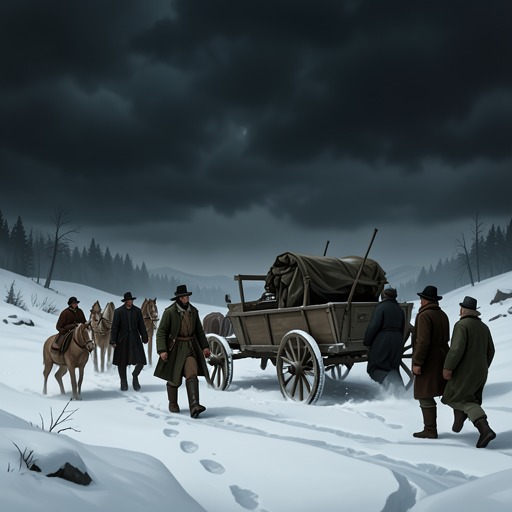
The decline of Butcher’s Crossing
Butcher's CrossingButcher’s Crossing declines as the trade that built it consumes its basis. The bison herds dwindle, the railway arrives on terms that do not rescue the town, and the bustling outpost becomes a nearly deserted collection of weathered buildings. Its fate is not a sudden reversal but the accumulated consequence of extraction and changing markets.
A settlement built on the hide trade
When William Andrews first encounters Butcher’s Crossing, J.D. McDonald describes it as a place sustained by hunters and the sale of hides. He distinguishes the hunters’ immediate use of the land for a living from his own ambitions to make the settlement something more, predicting that a railway will change its prospects. The town’s confidence in development is already tied to a trade that depends on the landscape it is transforming.
Miller recalls that he and McDonald arrived four years earlier, when the spring plains were black with bison for miles. A hunting party could then bring in a thousand or fifteen hundred animals in two weeks and obtain valuable spring hides. By the time he speaks to Andrews, the herds have dwindled to scattered groups, and a successful hunt yields only two or three hundred. Miller expects that within another year or two there will be no bison left to hunt in Kansas. His estimate makes the settlement’s prosperity look temporary: the more efficiently its hunters turn the herds into saleable hides, the faster the resource supporting the town disappears.
The remains of the animals make that depletion visible. Miller recalls riding through vast fields of bones during the great Kansas hunts, from Pawnee Fork to the end of the Smoky Hill, only five or six years earlier. He kicks at a large skeleton and notes that even these remains may soon be collected by farmers for fertilizer. The scene links the commercial hunt to a wider conversion of the plains: living herds become hides, while their bones are treated as another material to be put to use. On the journey west, the party also passes Indigenous families living in makeshift shelters beside a river. Miller dismisses them as people who live on hares and catfish, and as no longer worth shooting. Their brief appearance complicates the image of the region as empty frontier: the land is inhabited, even as the hunters’ perspective reduces its residents to an interruption on the route.
Signs of other economic forces appear alongside the decline of the bison. Andrews sees the railway’s parallel lines running across the plain toward the hills, and Miller stops to touch the smooth steel. The sight fulfils McDonald’s prediction that the railway would come, but its presence does not mean that the town’s original trade can continue. Elsewhere on the route, Miller notices tracks suggesting that cattle are being driven north from Texas, another sign that the plains are being reorganized for new forms of use. The railroad and cattle traffic mark change, not a guaranteed renewal of Butcher’s Crossing.
The resource base is exhausted
The railway and cattle tracks make the plains look newly open to development, but the hunting party’s passage into Bison Valley reveals the older trade consuming its own foundation. After crossing the mountains, the men descend toward a long, level valley, where grass runs between steep, pine-covered slopes. At first the place appears untouched: Andrews is so struck by its stillness that he holds his breath, wary of disturbing it. Then Miller points out a dark mass moving below the trees. The herd is nearly half a mile wide and more than a mile long, a concentration of bison that turns the remote valley into the last great reserve behind the declining Kansas hunts.
The men’s arrival converts that apparent abundance into an industrial rhythm of killing and processing. Miller shoots faster than Andrews and Fred Schneider can skin and butcher the animals. They work late and rise before dawn to cut into carcasses stiffened by the night; through the day, Miller’s rifle keeps sounding across the valley, monotonous enough to wear on their nerves. The hides are the object of the expedition, but the bodies left behind accumulate across the grass. The valley’s stillness gives way to a landscape of exposed carcasses and the rancid smell of decay, while the remaining bison continue to graze among the dead.
As the herd shrinks, Andrews realizes that Miller has never intended to leave while any bison remain alive. He measures the passage of time not by days, as Schneider does, but by the number of animals left to kill. The same logic that had made the Kansas hunts so productive now drives the expedition toward total extermination. Andrews can scarcely recall the plains they crossed or Butcher’s Crossing itself; the town and the world beyond the mountains have receded into something dreamlike, while the valley seems to give his existence its shape. That absorption registers the cost of the trade on both sides: the hunters destroy the resource that supports the settlement, and the hunt narrows their sense of life to the diminishing herd.
A railway that does not revive the town
When Miller and William Andrews return after the winter, the outskirts initially suggest that the hide business has flourished in their absence. Bundles of hides crowd the ground around McDonald’s small office, spill along the fence enclosing the salt vats, and lie beside a dozen or more abandoned wagons. Some wagons stand crooked, their wheels sunk into the earth as grass grows through the rims; others have been overturned, their metal fittings rusting in the sun. The apparent abundance is already marked by neglect. Miller is struck by the sight, but inside the office they find scattered papers and open ledgers, an overturned chair, and records so worn that their ink has faded. McDonald has not been there for a long time.
The village offers no sign of the bustle the hunters’ loads might imply. Its single street is nearly empty: a faint hammering comes from the blacksmith’s shop, the stable holds two horses before empty troughs, and torn muslin stirs at the lodging house. Outside Jackson’s Saloon, two unfamiliar men rise from a bench to watch the returning party. Miller looks them over and recognizes neither. Later, a woman describes the recent months as quiet, with no hunters, but expects the settlement to revive in autumn. Her optimism resembles McDonald’s earlier confidence in the railway: both imagine that another season or a new connection can restore activity, though neither can point to evidence that the old trade is recovering.
The railway has arrived, but not where McDonald had imagined its benefits. When Miller confronts him, McDonald says that the line is being laid fifty miles to the north. Its presence instead exposes how the value of the hunt has shifted: hunters sell bison meat to the railway company and leave the hides to rot where they were stripped from the animals. McDonald observes that Miller might have earned almost five cents a pound for the meat he abandoned to flies and wolves. The remark makes the expedition’s immense labor and killing newly futile—not because the animals were worthless, but because the market rewarded a different part of each carcass, and the hunters had not preserved it. The railroad carries away a use for the bison while bypassing the settlement’s dependence on hides.
By the time William Andrews rides out, the settlement appears less like a town awaiting renewal than a remnant already returning to the plain. The remains of McDonald’s office are still smoking. At dawn, the wooden buildings seem like a small heap of ruins; Andrews anticipates that their materials will be salvaged, the sod huts eroded by weather, and prairie grass slowly covering the road. His forecast completes the contrast between McDonald’s hoped-for transformation and the town’s actual trajectory: the railroad passes at a distance, the trade that sustained Butcher’s Crossing has lost its market, and the settlement’s remaining structures are destined to disappear into the landscape.
The settlement against the immensity of the West
From the bare hotel room, William Andrews watches Butcher’s Crossing and the country beyond it, but the village offers only a temporary point of orientation. His gaze keeps moving west, toward the river and the horizon, whose sharp line blurs in the heat until land and sky seem to lose their boundary. At night, a lit doorway or a match briefly restores the scale of the human world around him. This shifting perception gives the settlement a significance beyond its trade: it is a small, provisional foothold at the edge of a landscape that resists being bounded or possessed. The same tension deepens when William Andrews later confronts the pine forest, which seems to dissolve into a measureless, frozen sea. Against that immensity, the town’s confidence in railways, commerce, and expansion appears fragile; its decline is one local expression of a wider limit to the human claim on the West.